Pinduoduo Temu intensifies efforts in the Mexican market, extending an olive branch to local sellers.
Created on 2025.04.30
1. Open to local sellers in Mexico
Temu has never stopped its pace of global expansion, and its global business landscape is getting larger, having secured many prime locations in e-commerce. This time, Temu is focusing on the Mexican market in Latin America, hoping to achieve further development here.
Recently, Temu, a cross-border e-commerce platform under Pinduoduo, officially launched its local seller program in the Mexican market, which means that starting from April 2025, any small and medium-sized enterprises registered in Mexico, as long as they have domestic inventory, can apply to settle on Temu. Prior to this, Temu's localization strategy in Mexico was invitation-only, open only to invited companies.

Open to local merchants in Mexico Source: vanguardia
This news is undoubtedly a bombshell, marking not only a new phase in Temu's strategic layout in the Mexican market but also signaling that the cross-border e-commerce industry is about to迎来 a new round of transformation. Since entering the Mexican market, Temu has achieved remarkable results with its unique business strategy and strong resource integration capabilities.
Analysis of data from Comscore shows that after Temu launched in the Mexican market, platform traffic experienced exponential growth. At the beginning of its launch, the visitor count for the Mexican site reached 311,000, and within just 6 months, the visitor count surged to 18.4 million, quickly becoming the third largest e-commerce platform in Mexico, only behind the two established e-commerce giants, Mercado Libre and Amazon, and even leaving behind older cross-border e-commerce platforms like AliExpress and Shopee.

Temu Mexico's rapid growth Image source: Comscore
Temu has achieved remarkable success in the Mexican market, and its pricing strategy is a key to unlocking the doors of the Mexican market. On the Temu platform, consumers can purchase a wide variety of products at astonishingly low prices, ranging from fashion apparel to home goods, from beauty and personal care to digital products, everything is available. This extreme price advantage has instantly captivated Mexican consumers who are highly focused on cost-effectiveness.
In addition to low prices, the series of thoughtful subsidy measures launched by Temu has also won the favor of a large number of consumers. Limited-time free shipping service, a 90-day free return policy, and a price adjustment commitment within a month further demonstrate Temu's emphasis on consumer rights, allowing consumers to feel real protection.
II. Mexico E-commerce Market
If we were to enumerate the current blue ocean market of cross-border e-commerce, the Mexican market would undoubtedly be on the list. Compared to regions like Europe, North America, Southeast Asia, and the Asia-Pacific, the level of market competition in Mexico is still relatively low, and it has a broader growth space. From this series of actions by Temu, we can also see that the Mexican e-commerce market contains enormous development potential.
In terms of market size, a report released by the Mexican Online Sales Association (AMVO) shows that the revenue of Mexico's online retail market reached 789.7 billion pesos (approximately 40.9 billion USD) in 2024, with a year-on-year growth of about 20%. This marks the sixth consecutive year of double-digit year-on-year growth for Mexico's e-commerce market. Behind this optimistic outlook are numerous strong driving factors.
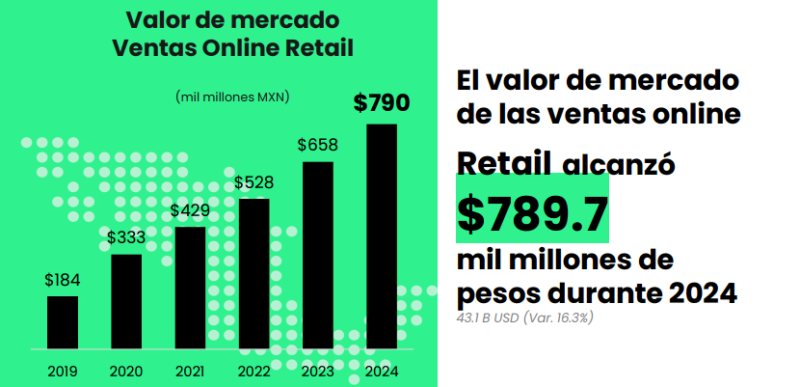
The value of the Mexican e-commerce market is 789.7 billion pesos. Source: AMVO
On one hand, Mexico's internet infrastructure is continuously improving, and the internet penetration rate is rising year by year. More and more Mexican citizens are accessing the internet, cultivating a large potential consumer group for the e-commerce market. On the other hand, the widespread adoption of smartphones has injected strong momentum into the development of e-commerce. In Mexico, smartphones have become an indispensable part of people's lives. Consumers are gradually developing the habit of shopping through their phones anytime and anywhere, and the mobile e-commerce market is showing explosive growth.
Facing the enticing cake of the Mexican e-commerce market, numerous cross-border e-commerce giants have already laid out their plans and are engaged in fierce competition.
Meituan, as a local e-commerce giant in the Latin American region, has a solid foundation in the Mexican market. With years of market cultivation, Meituan has established a comprehensive logistics distribution system and a localized service team, gaining in-depth understanding of the Mexican local market. Its platform offers a wide variety of products, covering all aspects of daily life, and has launched various special services tailored to the characteristics of Mexican consumers, such as installment payments and offline pickup points, which are well recognized by local consumers.

Product categories are diverse Source: Meikeduo Mexico site shopping webpage
Amazon naturally will not miss the development opportunities in the Mexican market. With its strong brand influence, rich product resources, and efficient logistics distribution network, Amazon quickly established a foothold in the Mexican market. Amazon has built multiple large logistics warehouses in Mexico, introduced advanced logistics technology and management systems, and achieved fast delivery services, providing consumers with a high-quality shopping experience. At the same time, Amazon focuses on the service quality of the platform and the control of product quality, attracting a large number of Mexican consumers who pursue high-quality products.

Open a logistics center Source: luznoticias
However, despite the broad prospects of the Mexican e-commerce market, cross-border e-commerce sellers face many severe challenges. The complex and ever-changing tax policies are a significant hurdle; the Mexican Tax Administration Service frequently adjusts tax policies for cross-border e-commerce, and the tax compliance requirements for sellers are becoming increasingly stringent.
Temu has opened its platform to local merchants in Mexico, marking the beginning of a new development phase in the Mexican cross-border e-commerce market. In this market full of opportunities and challenges, how Temu's initiative will reshape the market landscape, and how cross-border e-commerce sellers can seize opportunities and respond to challenges, is worth our continued attention and in-depth consideration. The future path of the Mexican e-commerce market is bound to be full of variables and excitement; let us wait and see.
Contact
Leave your information and we will contact you.


