Trump's tariff increase is like shooting himself in the foot
Created on 2025.04.11
1. Add another 50% tariff
With heavy tariff cuts, e-commerce players in the cross-border circle are facing greater challenges and are causing headaches.
A few days ago, Trump issued a "final ultimatum" for the trade war with China through social media: If China fails to withdraw the previously announced 34% tariff increase on U.S. goods within 24 hours, the United States will impose an additional 50% new tariff on Chinese goods exported to the United States starting April 9 and terminate all trade negotiations with China.
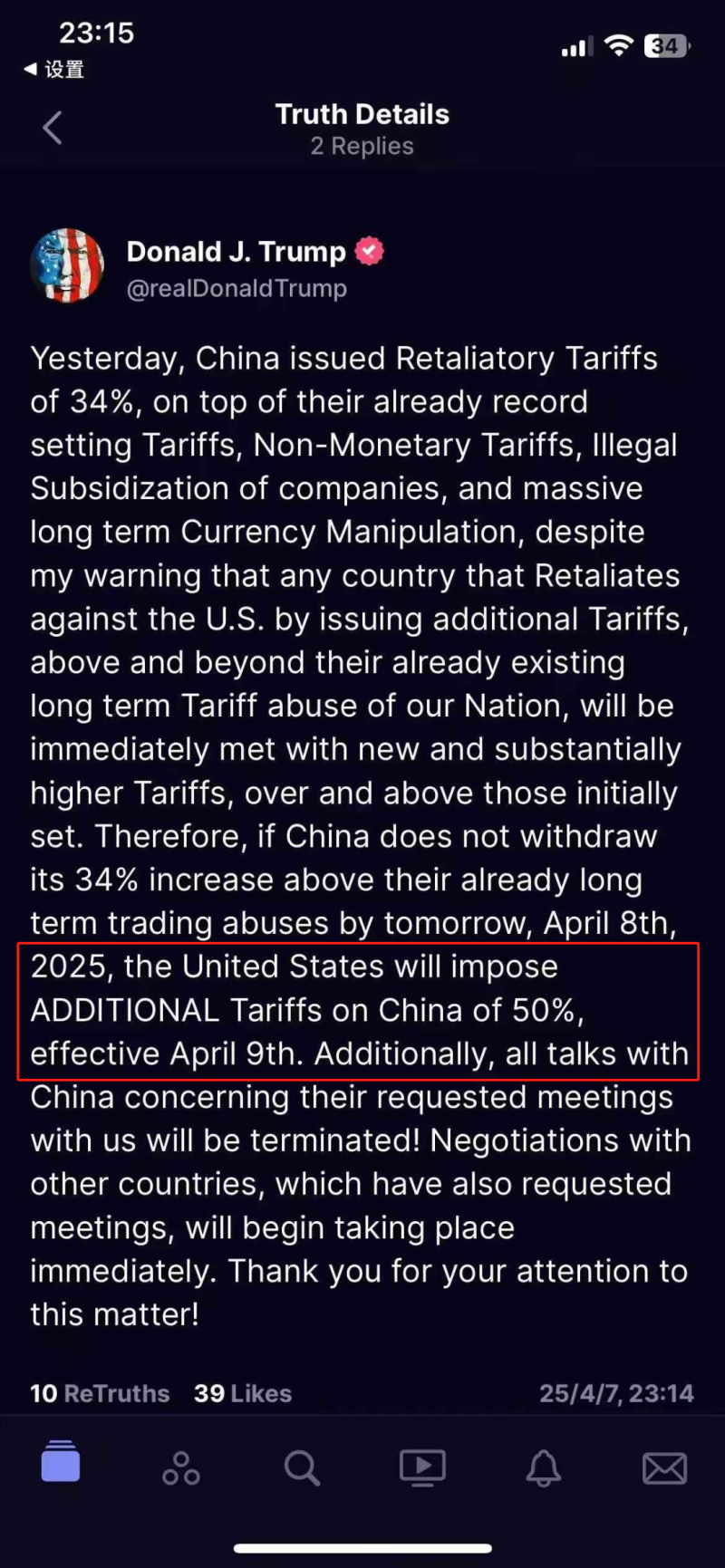
Threatening to impose another 50% tariff Source: Tell everything you know
This seemingly crazy tariff game is actually a "maximum pressure" strategy carefully planned by the Trump administration, but its cost is far beyond imagination. Before this, American billionaire Mark Cuban even reminded his fans on social platforms that it is time to start stockpiling.
Since Trump returned to the White House in 2025, he has imposed 20% tariffs on Chinese goods twice. Combined with previous policies, as of April 2, China's exports to the United States have been subject to an average tariff of 39%. The executive order signed on April 2 added another 34% tariff, and the cancellation of the tax-free quota for cross-border e-commerce below $800, the actual total tariff rate on Chinese goods has risen to 54%. If the latest 50% tariff is implemented, the comprehensive tariff on Chinese goods exported to the United States will be as high as 104%.
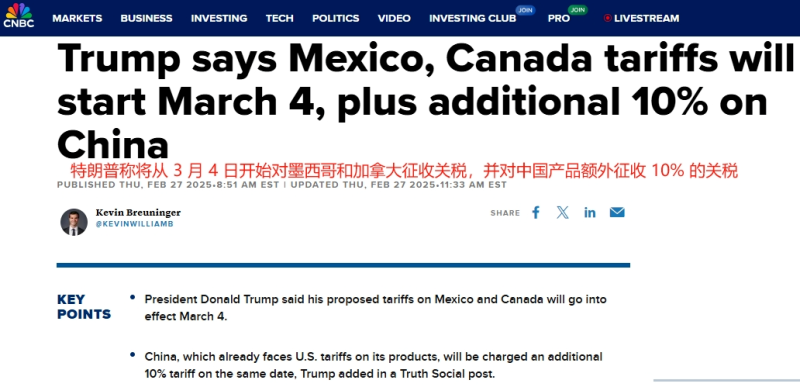
Previous news on tax increase Source: CNBC
Behind Trump's obsession with tariffs is an attempt to force China to make concessions by increasing the tariffs layer by layer, repeating the drama of forcing Mexico to accept the US-Mexico-Canada Agreement in 2018. Of course, we will never give in. In response, the spokesperson of the Ministry of Commerce made a statement on the US threat to escalate tariffs on China, saying that if the US escalates tariffs, China will resolutely take countermeasures to safeguard its own rights and interests.
2. Self-harm from tax hikes
In this tariff storm, cross-border e-commerce sellers have been hit in all directions. Trump's tariff policy has not only pushed up the cost of goods, but also triggered multiple crises in logistics, supply chain, market access, etc. However, this does not only affect cross-border e-commerce sellers, but American consumers and businesses will also bear a huge price.
From the perspective of the US market itself, Trump's threatening remarks may be shooting himself in the foot, and may even "kill" himself. Looking back at historical experience, the United States has repeatedly imposed tariffs but has not achieved the expected results. In 2018, the Trump administration imposed tariffs on Chinese goods in an attempt to solve the trade deficit problem, but the result was that American consumers borne most of the costs, corporate profits fell, and economic growth slowed down. The 50% tariff increase this time may also trigger similar negative effects.
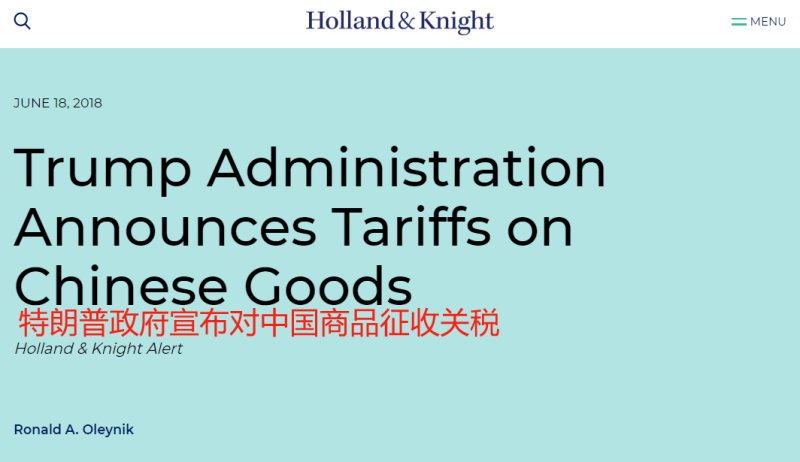
2018 tariff increase Source: Holland & Knight
In fact, the financial markets have also reacted strongly to Trump's series of tariff policies.
After the announcement of additional tariffs in March 2018 and May 2019, the US stock market fell sharply. The cumulative decline on the 11 days when the tariffs were officially announced reached 11.5%, which is equivalent to a loss of 4.1 trillion US dollars in market value. This time was no exception. Since Trump announced the "reciprocal tariff" policy, the US stock market has plummeted many times. On April 3, the three major US stock indexes even set a record for the largest single-day decline in the past five years. After Trump threatened to add another 50% tariff, the three major US stock indexes plunged as soon as they opened.

The three major U.S. stock indexes plummeted. Source: News Broadcast
Trump's series of tariff policies seem to be suppressing Chinese cross-border e-commerce, but in fact they are shooting themselves in the foot. American consumers and businesses will pay a heavy price for this. Although cross-border e-commerce sellers will also be affected to a certain extent, they are not without countermeasures. The US market is important, but it is not the only choice for sellers. The Middle East, Africa, Russia and other regions are becoming new market opportunities. Cross-border e-commerce still has a promising future.
Contact
Leave your information and we will contact you.


